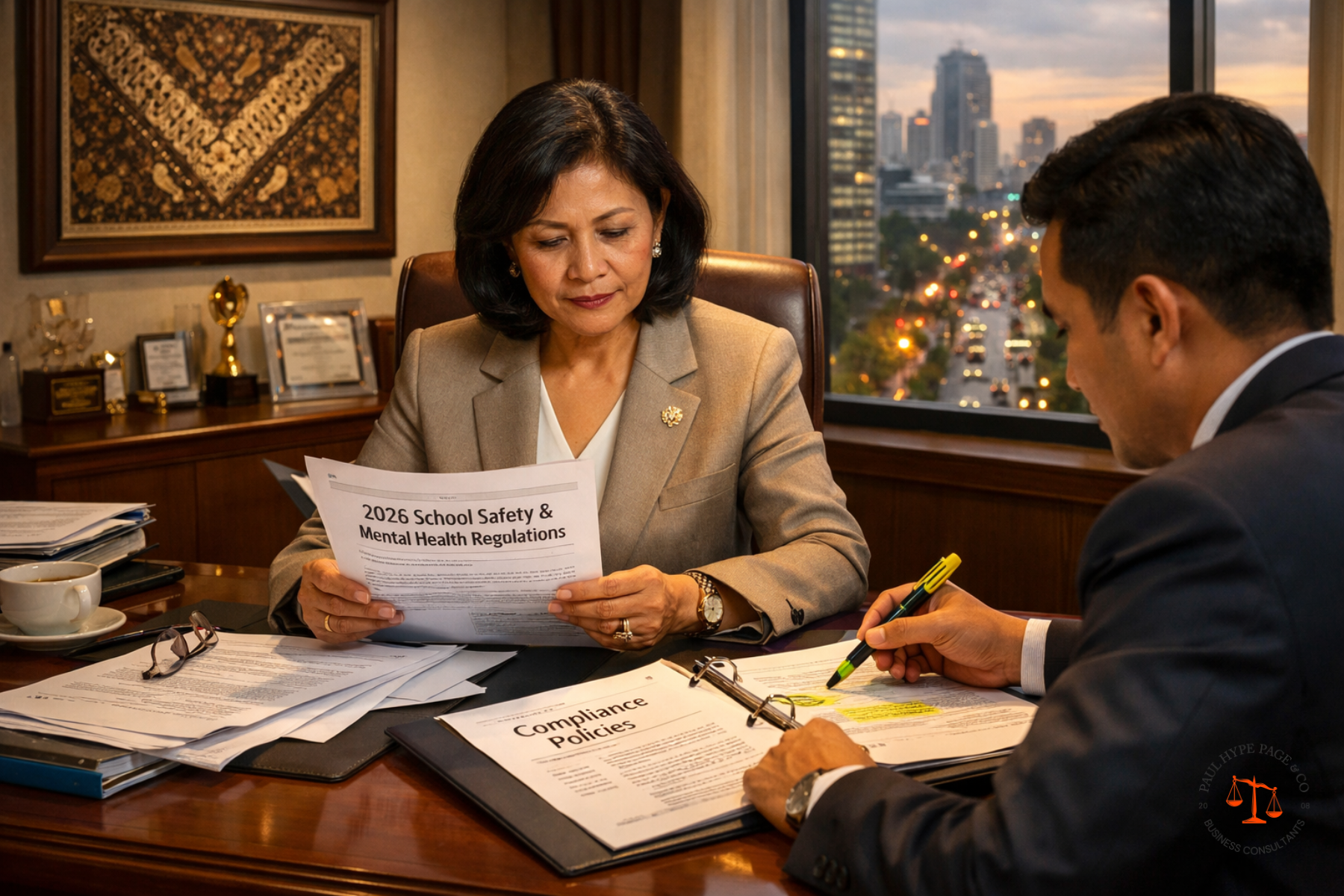
Indonesia’s education sector is seeing rising expectations from regulators, parents, and partners around safety, student wellbeing, and transparent governance. For PT PMA education operator groups (foreign investment companies) and local foundations operating schools, the operational work is only half the risk story—the other half sits in corporate governance, documented controls, and vendor oversight. In practice, an effective Indonesia Company Secretary function becomes the “system owner” for board processes, statutory compliance, and audit-ready evidence trails that support school safety compliance and emerging mental health regulation expectations. Looking ahead to 2026 and beyond, education businesses that standardise governance early tend to handle incidents, inspections, and partner due diligence more smoothly. Paul Hype Page & Co. (PHP) often supports multi-country groups with incorporation, corporate secretarial governance, accounting and tax readiness, and cross-border structuring so compliance work does not stay trapped in spreadsheets and inboxes.
What does an “Indonesia Company Secretary” function actually cover for an education business?
In Indonesia, the term “company secretary” is used differently across markets. In practice, the function is less about a single title and more about ensuring the company’s corporate compliance and governance machinery works.
For an education operator, this typically includes:
- Statutory administration: maintaining core corporate documents, registers, and filings (as applicable to your entity type).
- Board and shareholder governance: scheduling meetings, preparing agendas, recording resolutions, ensuring signatories are properly authorised.
- Policy-to-proof alignment: turning operational policies (e.g., campus safety SOPs) into governance artefacts—approvals, reporting lines, review cycles.
- Licensing and compliance coordination: coordinating with legal counsel and internal teams for education-related permits and reporting.
- Audit readiness: ensuring documentation is complete, consistent, and accessible for financial audits and governance reviews.
Education operators often underestimate this scope. When an incident occurs—injury, safeguarding allegation, data leak—your corporate records, approvals, and vendor contracts are often requested quickly. A well-run Indonesia Company Secretary function helps you respond with evidence, not explanations.
Where PHP can help: for groups operating across Singapore–Indonesia or wider ASEAN, PHP commonly helps align corporate secretarial calendars, board packs, and documentation standards so the Indonesia entity does not become the weak link in group governance.
Why do school safety compliance and mental health regulation matter to corporate governance (not just operations)?
Many school leaders treat safety and wellbeing as “campus issues.” But regulators, insurers, and commercial partners increasingly view them as governance issues: who is accountable, what is reported to the board, and whether controls are tested.
From a governance standpoint, school safety compliance and mental health regulation expectations commonly create four board-level needs:
- Clear accountability: named owners for safety, safeguarding, counselling, and incident escalation.
- Documented controls: written SOPs, training logs, risk assessments, emergency drills, and incident registers.
- Reporting and oversight: regular management reporting to directors (even if simplified) and documented board review.
- Continuous improvement: corrective action tracking after incidents, inspections, or parent complaints.
Common mistake: having strong operational SOPs but no governance trail. If a policy exists but was never approved, reviewed, trained, or audited internally, it becomes difficult to demonstrate control.
2026 prep guidance:
- Put safety and student wellbeing on the board agenda at least quarterly.
- Establish a simple incident classification matrix (minor/major/critical) with escalation triggers.
- Keep a single “compliance evidence folder” with controlled access and versioning.
This is where Indonesia audit & governance intersects with day-to-day campus management: the board needs assurance, and assurance needs evidence.
How does the entity type (PT PMA education operator vs foundation) change the compliance and risk profile?
Indonesia education groups often use one of these structures (sometimes both):
- PT PMA education operator (foreign investment company) for commercial operations and foreign shareholder participation.
- Yayasan (foundation) or local entities, where certain activities are run under a non-profit style governance model.
Your structure affects:
- Governance documents: articles of association/bylaws, board composition rules, approval thresholds.
- Related-party arrangements: service agreements, brand licensing, management fees, or campus leases between entities.
- Financial reporting and audit expectations: audit scope, consolidation needs, and evidence required for group reporting.
- Regulatory interactions: different reporting or licensing pathways depending on the activity and local rules.
Common mistake: mixing costs, staff, or contracts across entities without documented agreements. This can create tax risk, audit qualifications, and vendor legal risk (e.g., which entity is liable for a contractor’s negligence).
2026 prep guidance:
- Map your “operating model”: who hires staff, who invoices tuition, who signs vendor contracts, who owns/leases the campus.
- Document intercompany services and cost-sharing with clear deliverables and pricing logic.
- Standardise signatory matrices so principals and campus heads do not sign contracts beyond authority.
PHP support (subtle but practical): PHP can coordinate incorporation/structuring decisions across jurisdictions, and then connect the dots with accounting, payroll setup, and corporate secretarial governance so entity boundaries match how the school actually runs.
What governance documents should an Indonesia education operator have in place by 2026?
A useful approach is to separate “statutory corporate documents” from “operational governance documents.” The first keeps the company legal; the second keeps it defensible.
By 2026, many education operators aim to maintain the following (tailor to size and risk):
A. Corporate governance pack (board-level)
- Board/Shareholder resolutions and minutes (approved, signed, filed)
- Delegation of Authority (DoA) and signing limits
- Conflict-of-interest declarations (annual)
- Risk register (top 10–20 risks) with owners and mitigation plans
- Vendor approval policy and contract thresholds
B. School safety compliance evidence pack (operations-to-governance)
- Emergency response plan and drill calendar
- Facility maintenance logs (fire safety, electrical, playground checks)
- Safeguarding policy and reporting mechanism
- Incident register and corrective action tracker
- Training logs (first aid, child protection, crisis response)
C. Student wellbeing and mental health governance
- Counselling scope and referral pathways
- Confidentiality and data handling protocol
- Parent communication templates for sensitive incidents
- Staff training plan (recognition, escalation)
If you reference specific statutory obligations, the “effective date” and source matter. Where requirements vary by province/municipality or by licence type, it is safer to build a control framework that can be adapted rather than overfit to one interpretation.
Common mistake: storing these as unversioned Word files in personal drives. Audits and incidents require controlled versions and evidence of review.
2026 prep guidance:
- Create a document control index (owner, version, review date).
- Set annual review cycles with board acknowledgement.
- Use checklists for drills, maintenance, and staff onboarding.
How should you manage vendor legal risk in Indonesian schools (security, transport, canteen, IT, and contractors)?
Vendors are a major exposure point for schools because they operate on campus, interact with children, and influence safety outcomes. Vendor legal risk is not only about price—it’s about controllability.
A practical vendor risk framework for schools:
1) Categorise vendors by risk
- High-risk: security, transport, construction, playground installers, counselling providers, IT systems holding student data
- Medium-risk: cleaning, canteen, event operators
- Lower-risk: stationery supplies
2) Standardise contract clauses (as applicable)
- Scope of services and service levels
- Staff screening/eligibility requirements and replacement rights
- Insurance requirements (where commercially reasonable)
- Incident reporting timelines and cooperation duties
- Data protection and confidentiality (especially edtech)
- Audit/inspection rights and compliance with campus rules
- Termination triggers for safeguarding or safety breaches
3) Implement vendor onboarding and renewal controls
- Due diligence checklist (company info, references, permits, safety SOPs)
- Campus induction and training sign-off
- Annual performance review and incident review
Concrete example:
- A school outsources student transport. A minor accident occurs. Parents ask: who is liable, what checks were done, were drivers trained, and what is the escalation protocol? If the contract is silent and no onboarding evidence exists, the operator bears reputational and legal risk even if the vendor is “at fault.”
2026 prep guidance:
- Build a template MSA (master service agreement) and vendor code of conduct.
- Tie vendor payments to completion of safety documentation (not as punishment, but as a control).
PHP can help align vendor governance with accounting controls (e.g., vendor master setup, approval workflows) so the compliance process survives staff turnover.
How do you set up Indonesia audit & governance so safety and wellbeing controls are “auditable”?
Auditors focus on financial statements, but governance reviews (internal, investor, insurer, or partner due diligence) often ask for evidence that your control environment is real.
To make safety and wellbeing controls “auditable,” design them like financial controls:
- Defined owners (job titles, not names)
- Frequency (monthly checks, quarterly reviews)
- Evidence (logs, sign-offs, photos, attendance sheets)
- Exceptions (what happens when something fails)
- Retention rules (how long you keep records)
A simple 3-line control description format works well:
- Control: Fire drill conducted each term.
- Owner: Campus Operations Manager.
- Evidence: Drill checklist + attendance + issues log + corrective actions.
Common mistake: collecting evidence only after something goes wrong. Backfilled logs can be easy to challenge.
2026 prep guidance:
- Create a “controls library” that lists your 20–40 key controls.
- Conduct one internal mock review per year (spot check 5 controls) and report results to directors.
Where PHP support fits: PHP teams often help connect finance/audit readiness with governance processes—ensuring approvals, minutes, and control evidence align with your accounting records and payroll processes.
What are the most common compliance gaps for a PT PMA education operator entering Indonesia?
Foreign founders often bring strong operational standards, but Indonesian execution risk can sit in administrative detail and entity discipline.
Common gaps seen in practice:
- Blurry authority lines: country head signs leases or vendor contracts without proper approvals.
- Inconsistent documentation: different campuses use different incident forms and retention practices.
- Unclear employer-of-record: teachers hired by one entity but managed by another.
- Tax and payroll misalignment: allowances, reimbursements, or benefits not clearly classified.
- Licence and activity mismatch: business activities not mapped cleanly to the entity’s registered scope.
Concrete example:
- A school engages a psychologist as an independent contractor, but operationally treats them like an employee (fixed hours, supervision, tools provided). This can create labour and tax classification questions, and it intersects with mental health regulation expectations around qualifications and confidentiality.
2026 prep guidance:
- Build a country-specific governance calendar: statutory deadlines, licence renewals, annual meeting cycles.
- Standardise HR files and contractor files separately.
- Create a single source of truth for headcount, campus assignments, and cost centres.
PHP support: for multi-country education groups, PHP can help set up entity governance, payroll processes, and reporting standards so group HQ receives consistent information across markets.
How should education businesses handle data, confidentiality, and student wellbeing records as mental health expectations rise?
As mental health regulation and expectations evolve, schools often handle more sensitive data: counselling notes, incident reports, safeguarding allegations, and medical information.
Even where specific statutory rules differ, the governance principles are consistent:
- Data minimisation: collect only what is needed.
- Access control: define who can view counselling and safeguarding records.
- Segregation: separate HR performance files from student wellbeing files.
- Retention and disposal: set retention periods; avoid indefinite storage.
- Incident response: have a process for data breaches or unauthorised disclosures.
Common mistake: storing counselling notes in shared drives or sending sensitive details over informal channels.
2026 prep guidance:
- Maintain a data map of systems (SIS, LMS, counselling files, HRIS).
- Add confidentiality clauses into employment and vendor contracts for roles handling sensitive data.
- Train staff annually on incident reporting and confidentiality.
This is also a vendor legal risk issue: edtech providers, cloud storage vendors, and outsourced counsellors should be held to clear contractual and operational standards.
What board and management reporting helps directors oversee school safety compliance effectively?
Directors do not need every detail, but they do need a consistent dashboard and escalation mechanism.
A practical quarterly dashboard might include:
- Number of incidents by category (injury, safeguarding, facility, transport)
- High-severity incidents summary with corrective actions
- Drill completion rates and key maintenance exceptions
- Staff training completion rates (first aid, safeguarding)
- Vendor incidents and vendor performance flags
- Student wellbeing indicators (high-level, non-identifying)
What should trigger immediate escalation?
- Any alleged safeguarding/abuse incident
- Serious injury or hospitalisation
- Repeated facility failures (e.g., fire safety issues)
- Data breach involving student records
- Vendor misconduct on campus
Common mistake: reporting only “numbers” without actions. Directors need to see what changed after an incident.
2026 prep guidance:
- Define a one-page “board incident escalation policy.”
- Ensure board minutes document key discussions and approvals.
- Run one annual tabletop exercise (crisis simulation) and minute the outcomes.
An Indonesia Company Secretary function typically helps ensure reporting rhythms exist and that the evidence trail is maintained.
How do accounting, tax, and payroll processes affect governance for Indonesia education operators?
Finance processes are governance processes. Weak payroll and vendor payment controls often translate into compliance failures.
Education-specific finance governance areas:
- Payroll accuracy and classification: teachers’ allowances, overtime, reimbursement policies.
- Vendor payments tied to documentation: do not pay high-risk vendors without required safety docs.
- Petty cash controls on campus: clear limits and receipts, especially for maintenance and events.
- Budget ownership: who approves emergency repairs; how urgent procurement is documented.
Concrete example:
- A campus buys emergency repairs using petty cash without vendor invoices. Later, an incident triggers a review of maintenance history, and the paper trail is incomplete. This is both a finance control weakness and a safety governance weakness.
2026 prep guidance:
- Set up cost centres per campus for transparency.
- Implement approval workflows in accounting systems where possible.
- Align HR onboarding with payroll setup (bank details, tax status, contract type).
PHP support: PHP can assist with accounting system setup, payroll processing, and audit readiness—while coordinating with corporate secretarial governance so approvals and records align.
What should a 2026 governance calendar look like for an Indonesia school or education group?
A governance calendar turns compliance into routine. It reduces last-minute filings and makes safety reviews predictable.
A practical 12-month calendar may include:
Monthly
- Campus incident summary review
- Vendor performance check (high-risk vendors)
- Facilities maintenance exception report
Quarterly
- Board dashboard review (safety, wellbeing, major risks)
- Staff training completion tracking
- Data access review for sensitive records
Biannual
- Vendor contract renewal and due diligence refresh (high-risk)
- Emergency response drill program review
Annual
- Board review of risk register and key policies
- Conflict-of-interest declarations
- Internal mock audit of 5–10 key controls
- Review of delegation of authority and signatory lists
Common mistake: treating statutory filings as the only “compliance.” Operational compliance needs its own cadence.
PHP can help clients build a combined statutory + operational governance calendar and integrate it into board packs and compliance trackers.
How should foreign founders structure cross-border oversight without slowing Indonesian operations?
Foreign HQ often wants control; Indonesian teams need speed. Good governance finds a middle path.
A workable model:
- Local operational decisions within delegated limits (e.g., repairs under a threshold).
- HQ approvals for high-risk matters: leases, major vendors, child safeguarding incidents, core IT systems, key hires.
- Clear templates: board memo templates for approvals, incident reporting forms.
Common mistake: approvals via chat with no formal record. If something goes wrong, it is unclear whether the board approved it.
2026 prep guidance:
- Define “reserved matters” requiring director/shareholder approval.
- Standardise bilingual templates (where helpful) for contracts and board memos.
- Ensure intercompany reporting aligns with group consolidation needs.
PHP often supports multi-country groups by harmonising governance and reporting formats across Singapore, Indonesia, and other markets so group oversight is consistent but not obstructive.
When does immigration or work pass strategy matter for Indonesia education groups (and how does it link to compliance)?
While work pass terminology like EP vs S Pass is Singapore-specific, education groups often have a regional leadership team and may rotate staff across markets.
In practice, workforce planning intersects with compliance in three ways:
- Role clarity: who is responsible for safety, safeguarding, counselling, and data controls.
- Training and competency: ensuring qualified personnel are present locally and documented.
- Continuity: avoiding governance gaps during leadership transitions.
Concrete cross-border example:
- A Singapore HQ appoints a regional safeguarding lead based in Singapore (where EP/S Pass planning may apply) while Indonesia has a local compliance manager. Without a clear RACI (responsible/accountable/consulted/informed) and documented escalation path, incidents can fall between teams.
2026 prep guidance:
- Map critical compliance roles and backups.
- Maintain handover checklists for campus leadership changes.
PHP can advise on regional mobility planning where relevant (including Singapore work pass considerations) so leadership structures remain compliant and operationally effective.
What are practical first steps to implement stronger Indonesia audit & governance in the next 90 days?
If you are preparing for 2026, the goal is to stabilise the system first, then refine.
A 90-day implementation plan:
Days 1–30: Diagnose and map
- Confirm entity structure and signing authorities
- Build a compliance obligations list (statutory + operational)
- Identify high-risk vendors and contract gaps
- Choose standard incident and safeguarding forms
Days 31–60: Standardise
- Implement delegation of authority and procurement thresholds
- Roll out vendor onboarding checklist
- Create board dashboard template and escalation policy
- Centralise document control with versioning
Days 61–90: Test and evidence
- Run one drill and one tabletop exercise; document outcomes
- Perform a mock control check on 5 items (maintenance logs, training attendance, vendor docs)
- Prepare a board pack and minute key approvals
Common mistake: starting with complex software before agreeing on forms, owners, and evidence.
PHP support: PHP can help coordinate corporate secretarial governance, finance controls, and multi-entity structuring so implementation is not piecemeal.
How can PHP support Indonesia education operators without turning compliance into a bureaucracy?
Well-designed compliance should reduce friction, not add it. The goal is to create repeatable controls that survive growth and staff turnover.
Education operators typically seek support in four areas:
- Company incorporation & structuring (multi-country): aligning Indonesia entities with Singapore/HK holding structures and commercial realities.
- Accounting, tax, payroll, audit readiness: setting up finance controls that support reporting and evidence trails.
- Corporate secretarial & compliance: governance calendars, resolutions, director oversight, documentation discipline.
- Workforce mobility planning: when regional leaders sit in Singapore or elsewhere, aligning roles, approvals, and continuity.
The most effective approach is usually modular:
- Start with entity governance and signatory discipline.
- Then link procurement, vendor management, and payroll to approval workflows.
- Finally, build board reporting around school safety compliance and mental health regulation readiness.
If you are planning for 2026 and want clarity on governance gaps, vendor legal risk, or how to structure a PT PMA education operator for audit-ready growth, speaking with an experienced regional advisor early can reduce rework and help you build a system that is practical to run.
Conclusion
For Indonesia education operators, school safety compliance and student wellbeing expectations are no longer only operational matters—they are governance matters that need board oversight, documented controls, and auditable evidence. A strong Indonesia Company Secretary function helps translate policies into approvals, reporting cadences, and documentation discipline, while Indonesia audit & governance readiness depends on consistent records, vendor controls, and aligned finance processes. Heading into 2026 and beyond, the operators that map their entity boundaries (including PT PMA education operator structures), standardise vendor onboarding to reduce vendor legal risk, and build a simple governance calendar tend to respond faster to incidents and due diligence. The work is not about bureaucracy; it is about clarity, accountability, and defensibility as expectations rise.
FAQs
Use a risk-tiered vendor framework with standard contract clauses (screening, incident reporting, confidentiality/data protection, audit rights) and a documented onboarding/renewal checklist. Tie vendor approval and payment workflows to completion of required safety and compliance documentation.
Typically: a delegation of authority/signatory matrix, minutes/resolutions, risk register, vendor approval policy, incident register with corrective actions, training logs, drill records, and controlled versions of safeguarding and wellbeing policies with review cycles.
Entity type affects governance rules, approval thresholds, contracting liability, and how related-party arrangements should be documented. Many issues arise when staff, costs, or vendor contracts are shared across entities without clear agreements and signatory authority.
Because regulators, insurers, and partners increasingly assess accountability, oversight, and proof of control—not just operational intent. Boards are expected to review incidents, approve key policies, and track corrective actions with clear evidence.
It manages statutory compliance, board/shareholder processes (minutes, resolutions, authorisations), and document control. For schools, it also helps convert safety and wellbeing policies into governance artefacts that are inspection- and audit-ready.
Share This Guide, Choose Your Platform!
Related Business Articles